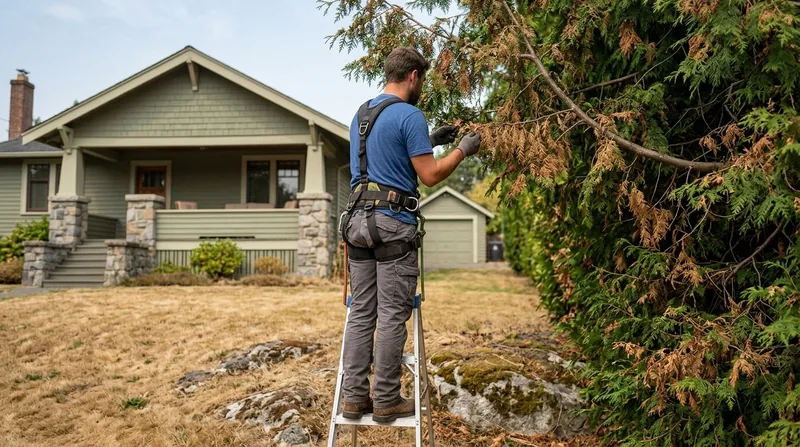




Cedar and conifer dieback treatment in Victoria addresses the browning, thinning crowns and drought stress that affect western redcedar, Douglas-fir and hemlock across the region. Victoria's wet winters and dry summers create ideal conditions for decline, particularly in tall yard cedars and second-growth conifers on clay-heavy lots. Harbour City Tree Trimming diagnoses the cause, thins crowns to improve air flow, amends soil and establishes irrigation to restore vigour. Our ISA Certified Arborists have treated hundreds of stressed conifers since 2013. Learn more about tree disease diagnosis.
Why cedar and conifer decline matters in the Victoria area
Western redcedar is the signature tree of Victoria's neighbourhoods, framing properties as tall single specimens or clipped hedges. When drought stress, poor drainage or soil compaction triggers dieback, the tree weakens from the top down, branches thin, foliage browns and the entire structure fails within two to three years. Early intervention stops the decline and restores the tree's ability to photosynthesize and defend itself against pests.
- We assess root zone moisture, soil compaction and drainage to identify the primary stressor.
- We thin the crown selectively to reduce water demand and improve air circulation through the canopy.
- We recommend deep watering schedules and mulching to stabilize soil moisture through dry summers.
- We amend clay with organic matter and aeration to improve root health and nutrient uptake.
- We monitor the tree over the following season to confirm recovery and adjust care as needed.
Treating decline early costs far less than removing a dead tree and replanting, and preserves the mature structure that took decades to establish.
Info key: A 15-metre western redcedar showing crown thinning and browning tips in Saanich or Central Saanich typically requires one to two seasons of crown thinning, soil amendment and irrigation to stabilize and regain density. Early treatment can recover 70 to 80 percent of the crown.
How we treat cedar and conifer decline
Diagnosis comes first. We inspect the crown for browning pattern, measure soil moisture, probe for root collar issues and examine the site for drainage problems. A stressed cedar often sits in compacted clay or receives water pooling from roof runoff, while a neighbouring hemlock on a slope may suffer from wind exposure and shallow root depth. Each tree requires a custom plan.
- We perform a detailed site assessment, including soil moisture testing and visual crown inspection.
- We remove dead and diseased wood, then thin the crown by 15 to 25 percent to reduce water stress.
- We apply organic mulch to the root zone to regulate temperature and moisture retention.
- We install deep watering guidance or recommend summer irrigation to sustain the tree through dry periods.
- We follow up in spring and summer to monitor new growth and adjust care recommendations.
The goal is to restore the tree's natural defence mechanisms so it can outcompete pathogens and pests on its own. See our pricing for cedar and conifer care.
Real example: A 12-metre redcedar in View Royal had thinned crown and browning lower branches due to soil compaction from a new driveway. We removed 20 percent of the outer crown, added 10 centimetres of arborist mulch, and installed a soaker line. By the following summer, new growth appeared and the tree regained 60 percent of its foliage density.
Treatment methods and what works best
| Method | Description | Best for |
|---|---|---|
| Crown thinning | Remove 15 to 25 percent of outer branches to reduce water demand and improve air flow through the canopy. | Trees with dense, stressed crowns or poor air circulation from neighbouring growth. |
| Root zone aeration | Break up compacted clay and create pathways for water infiltration and root expansion without damaging the root collar. | Trees in heavy clay or with visible soil compaction from construction or foot traffic. |
| Organic mulching | Apply 10 centimetres of wood-based mulch to regulate soil temperature, retain moisture and suppress competing weeds. | All stressed conifers, especially those in clay with summer drought exposure. |
| Deep watering and irrigation | Install soaker lines or recommend hand watering protocols to deliver water to the root zone during dry months without wetting the foliage. | Trees in ravine lots or on slopes where summer rainfall is sparse and roots struggle to access moisture. |
| Deadwood removal | Prune out dead branches and branch tips to reduce pest harbouring and improve the tree's appearance while it recovers. | Any tree showing browning tips or fully dead interior branches. |
| Soil amendment | Incorporate compost, aged bark and mycorrhizal inoculants to improve soil structure, drainage and nutrient availability in clay-heavy sites. | Trees in poor soil or where root health is limiting recovery. |
Timing and seasonal care in Victoria
Structural pruning and crown thinning are best done in dormancy, from late fall through late winter, when the tree is not actively growing and pruning wounds heal more slowly but with less risk of disease entry. Hedge trimming happens in late spring and summer after we check for active bird nests, which are protected under provincial law. Deep watering of stressed cedars must continue through the dry months from June to September, when rainfall drops and soil moisture becomes the limiting factor.
- Schedule crown thinning and deadwood removal between November and March for best healing.
- Conduct nesting checks in spring before any pruning work begins on hedges or dense crowns.
- Install irrigation or establish watering routines before the dry season begins in late May.
- Water deeply once or twice per week during summer if rainfall is less than 25 millimetres per week.
- Monitor for new growth in spring and summer to confirm the tree is recovering.
Delaying treatment through spring and summer allows the tree to enter dormancy in better condition, and avoids pruning during the season when it is most vulnerable to pest and disease pressure.
What to expect from Harbour City Tree Trimming
We arrive with certified staff, assess the site thoroughly and explain the diagnosis in plain language. We provide a written estimate that breaks down the work and the reasoning behind each step. Our crews work cleanly, removing all debris and leaving the site tidy. We respect approach distances to private electrical service entrances and follow all local regulations. If the City of Victoria requires an arborist report for your property, we can provide one to support your permit application.
We are a fully insured, local company with ISA Certified Arborists on staff. Contact us for a free estimate and we will visit your property, diagnose the problem and recommend the best course of action. Call (778) 562-9545 or fill out our contact form to get started.
Prices Cedar & Conifer Dieback Treatment in Victoria — Indicative pricing
| Service | Price | Details |
|---|---|---|
| Crown thinning (small to medium tree) | From $450 | Selective removal of 15 to 25 percent of outer branches to reduce water stress and improve air circulation |
| Crown thinning (large or tall tree) | From $750 | Extensive thinning on trees over 15 metres or difficult access; includes deadwood removal |
| Root zone aeration and mulching | From $300 | Soil aeration, organic mulch application and initial watering guidance for one tree |
| Irrigation setup and soil amendment | From $500 | Soaker line installation, compost incorporation and mycorrhizal inoculant application |
| Full treatment plan (diagnosis, pruning, soil work and irrigation) | From $1,200 | Complete assessment, crown thinning, aeration, mulching and watering system for one stressed tree |
| Free estimate | No charge | Site visit, diagnosis and written recommendation within 24 hours at (778) 562-9545 |
Indicative prices; free, personalized estimate within 24h at (778) 562-9545.