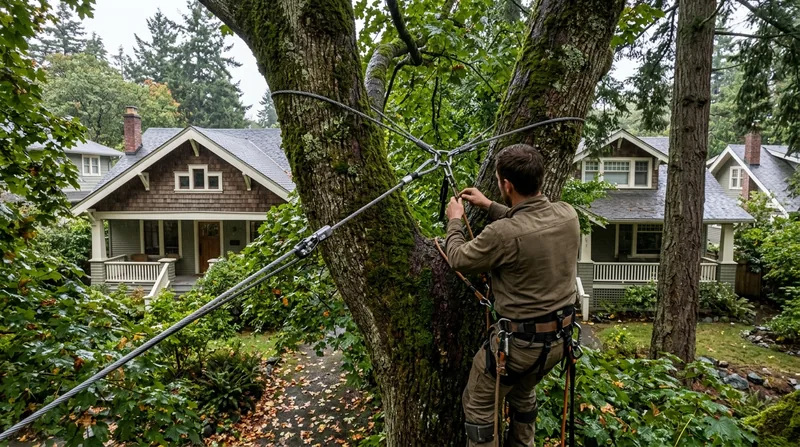




Tree cabling and bracing in Victoria stabilizes mature trees with structural weakness, split stems, or uneven weight distribution without removing them. The Victoria area's mix of tall second-growth Douglas-fir, western redcedar hedges, and mossy big-leaf maple on steep ravine lots creates ideal conditions for this work. Heavy wet clay and windstorms put pressure on trees that might otherwise stand for decades. Our ISA Certified Arborists assess each tree's structure, install dynamic cabling systems, and document the work so you retain valuable trees while protecting your property and neighbours. Contact us for a free estimate.
Why tree cabling and bracing matters in the Victoria area
Trees with weak branch unions, co-dominant stems, or uneven canopy weight are accidents waiting to happen. Victoria's wet winters and dry summers stress cedars and firs, and spring storms often snap limbs or split trunks on rain-saturated ground. Cabling does not cure the defect, but it redistributes load, slows the rate of failure, and buys years or decades of safe use. When removal is not the right choice, dynamic cabling is the professional intervention.
- We inspect the tree's structure and identify the weak point or points.
- We install cable hardware (typically stainless steel) above the weak union to share the load.
- We use dynamic systems, not rigid ones, so the tree can still move in wind and strengthen itself over time.
- We document the installation with photos and notes for your records and your insurer.
- We monitor the system on follow-up visits and adjust if needed.
This approach keeps heritage trees, mature shade trees, and trees with ecological value standing safely on your property.
Key info: A mature Douglas-fir or western redcedar with a split stem or weak crotch can live another 20 to 40 years under cable support. Without it, the same tree may fail in the next major windstorm. Cabling is often $800 to $2,500 depending on the number of cables, height, and access, compared to $2,000 to $5,000 for removal and stump grinding.
How we install tree cabling and bracing
Our process begins with a detailed inspection. We climb or use a bucket truck to examine the structure, measure angles, and identify the failure point. We then select the right cable system, position the hardware to minimize bark damage, and install the cables with precision. The work is clean, documented, and completed in one visit for most trees.
- We climb the tree or use equipment to access the weak union safely.
- We install cable anchors or bolts above the weak point, never girdling the trunk.
- We run stainless steel cable between the anchors to share the load across multiple stems or sections.
- We tension the cable to support the weight without over-constraining the tree.
- We photograph and label the system so you know exactly what was done.
The entire installation respects the tree's ability to move and strengthen itself. Rigid bracing is rarely used in modern arboriculture because trees need flex to develop reaction wood and compartmentalize stress.
Local example: A big-leaf maple in Esquimalt with a co-dominant stem split 60 percent of the way up the trunk received two cables in late autumn. The tree remained in place and healthy throughout the following wet winter and dry summer. Cost was $1,200. Removal of a tree that size would have been $3,500 plus stump grinding.
Cabling systems and when to use them
| System Type | Description | Best For |
|---|---|---|
| Dynamic cable | Stainless steel cable between bolts or anchors, allowing the tree to flex and move in wind. | Most mature trees with weak unions or split stems; allows compartmentalization and new growth. |
| Rod bracing | Rigid rods connecting two stems or sections, preventing movement between them. | Narrow angle crotches or very young co-dominant trees where movement would worsen the split. |
| Combination (cable and rod) | Cables to share load; rods to stabilize the worst angle or prevent twisting. | Complex structures with multiple weak points or trees on steep ravine lots exposed to wind and rain. |
| Supplemental pruning | Removing weight from the weaker stem or limb before installing cables. | Trees with uneven canopy or heavy limbs on one side; reduces cable tension and extends system life. |
We choose the system based on the tree's age, species, defect severity, and location. A western redcedar with a split stem usually needs dynamic cable. A young Douglas-fir with a tight crotch may benefit from rod bracing. We explain the choice and the expected lifespan of the system during your free estimate.
Permits, safety, and best timing in Victoria
The City of Victoria may require a permit for work on certain trees, particularly if they are protected by local bylaw or if the work is part of a development. Cabling does not trigger removal permits, but we always check before starting and include permit research in our assessment. If a permit is needed, our arborist report supports your application and speeds approval. We also respect approach distances near private electrical service entrances and never work on or near BC Hydro's public distribution network. Spring and early summer work is checked for active bird nests before any cutting begins.
Structural cabling is best installed in late autumn through late winter, when trees are dormant and the canopy is lighter. This timing allows the tree to heal around the bolt holes and enter spring growth with the support in place. Emergency cabling for storm-damaged trees can happen year-round; we respond within 24 hours to dangerous situations. Learn more about our 24/7 emergency response.
After installation, we recommend a follow-up visit in one to two years to inspect the cables, check for bark growth around the bolts, and adjust tension if needed. This monitoring is not always included in the initial quote but is a worthwhile investment for high-value trees.
When cabling is the right choice
Cabling is not always the answer. If a tree is diseased, hollow, or has failed more than 50 percent of its structural support, removal is safer and more honest. But if the tree is otherwise healthy, has good crown condition, and the defect is a single weak point or uneven weight, cabling can extend its life significantly. Heritage trees, trees with cultural value, mature shade trees on residential lots, and trees that shelter neighbours' properties are all good candidates.
- The tree is structurally sound except for one weak union or split stem.
- The tree has cultural, ecological, or aesthetic value worth preserving.
- The tree is mature enough that removal would leave a gap in the landscape.
- The defect poses a real risk to property or people below.
- The cost of cabling is significantly less than removal and replacement.
Structural pruning often works alongside cabling to reduce weight on the weak side and improve the tree's long-term stability. Together, these interventions can save a tree for decades.
Getting started with a free estimate
Call us at (778) 562-9545 or request a free estimate online. We will visit your property, inspect the tree, explain the cabling system we recommend, and provide a clear quote. If you decide to proceed, we schedule the work at the best time of year and complete it professionally. If you prefer removal, we can discuss that option too. Our ISA Certified Arborists have been serving the Victoria area since 2013, and we are fully insured for all structural work. See all the neighbourhoods we serve.
Prices Tree Cabling & Bracing in Victoria — Indicative pricing
| Service | Price | Details |
|---|---|---|
| Single cable installation | From $800 | One cable between two anchor points, typical for a single weak union or split stem |
| Dual cable system | From $1,400 | Two cables to support multiple weak points or uneven weight distribution |
| Cable with supplemental pruning | From $1,800 | Cabling plus selective limb removal to reduce load on the weaker side |
| Rod bracing or combination system | From $2,000 | Rigid rods, dynamic cables, or both for complex structural defects |
| Follow-up inspection and adjustment | From $350 | One to two years after installation, check cable tension and bark healing. |
| Free estimate | No charge | Site visit, structural assessment, and written quote within 24 hours |
Indicative prices; free, personalized estimate within 24h at (778) 562-9545.