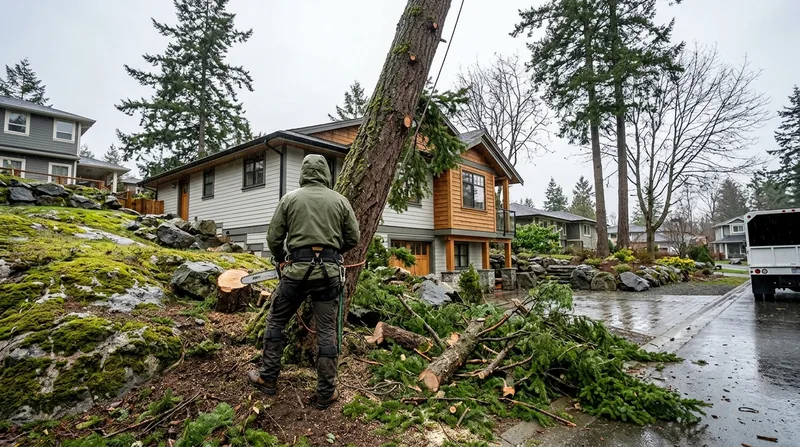




Tree removal in Victoria demands precision, local knowledge, and respect for the unique landscape that makes this region distinctive. Tall second-growth Douglas-fir, western redcedar hedges thinning from the top down after dry summers, and dense understory on steep ravine lots create removal scenarios that differ sharply from open suburban lots. Harbour City Tree Trimming has removed hazard trees across Victoria, Saanich, Esquimalt and the surrounding municipalities since 2013, working within municipal permitting rules and respecting the nesting windows that protect active bird sites. Whether a cedar is browning out, a storm has dropped a limb onto your roof, or a subdivision requires land clearing, our ISA Certified Arborists dismantle and haul away, leaving your property clean. Call us at (778) 562-9545 for a free estimate, or visit our contact page to request a quote.
Why tree removal becomes necessary in Victoria
Trees fail for predictable reasons across the Victoria area. Western redcedar, planted as tall screening trees in post-war subdivisions, develops dieback from the crown downward after consecutive dry summers, starving the lower limbs and leaving a hazard that will eventually shed branches or topple in a windstorm. Second-growth Douglas-fir, retained through land subdivision, may have been damaged during construction or may be competing for water in clay-heavy soil during drought. Big-leaf maple on wet ground, red alder along ravine edges, and ornamental cherry in established gardens all reach a point where they shed deadwood, lean against power lines, or threaten structures. A tree does not need to be dead to be dangerous; a crown that has lost half its foliage, a trunk with a deep crack, or a root plate lifted by wet-season soil movement all warrant professional assessment and removal.
- Dead or dying crowns that shed branches unpredictably onto roofs, fences or vehicles.
- Windthrow risk after rain-saturated ground loosens the root plate in autumn and winter storms.
- Encroachment on structures, hydro service lines, or neighbouring properties that requires formal removal rather than trimming.
- Municipal permitting rules in Victoria that often require an arborist report before removal, especially for larger trees or protected species.
- Land clearing for subdivision, renovation, or fire-hazard reduction across open acreage.
Removing a tree yourself with a chainsaw and a truck creates liability, injury risk, and often leaves a stump and root system that will regrow or damage underground utilities. Professional removal takes the hazard off your hands.
Local fact: A 20-metre western redcedar with advanced dieback in a Victoria West lot typically costs $1,200 to $2,000 to remove, dismantle in sections, and haul away. A 15-metre Douglas-fir on an open Colwood property may run $900 to $1,500. Stumps are addressed separately through stump grinding or full root removal.
How we remove trees across the Victoria area
Our approach depends on site constraints. A tree in a tight Victoria West lot surrounded by a house, hedge, and neighbour's fence demands sectional dismantling from the ground up, with each piece lowered by rope or rigged with pulleys to prevent damage to structures below. An open property in Langford or the Highlands allows felling in one or two drops, faster and more efficient. We assess access, drop areas, underground utilities, and proximity to BC Hydro lines before we begin. If the tree is near power lines, we document approach distances and refer the customer to BC Hydro if the crown is touching the public distribution network; we do not work on those lines ourselves. Active bird nests, if found during a spring or early-summer inspection, delay work until the nesting season ends.
- Inspect the tree, site, and surroundings to plan the safest removal method and identify any municipal permit requirements.
- Obtain or support your permit application with an arborist report if the City of Victoria or another local authority requires one before removal.
- Dismantle the tree in sections using ropes, pulleys, or bucket trucks, lowering each piece to the ground to avoid damage to nearby structures.
- Chip or haul away all limbs, trunk sections, and debris; leave the site clean and clear.
- Grind or remove the stump separately if you wish to replant or restore the area.
The entire process, from first assessment to final cleanup, is handled by our crews. You do not arrange sub-contractors or manage debris disposal yourself.
Example: A 25-metre Douglas-fir in a Saanich backyard with a deck 8 metres away was felled in two sections using ropes and rigging. The trunk was cut into 2-metre logs for chipping, and the site was cleared in one working day. Total cost was $1,650 including haul-away. No permit was required because the tree was on private land and did not trigger the City's replacement-planting threshold.
Removal methods and when to use them
| Method | Description | Best for |
|---|---|---|
| Sectional dismantling | Tree cut in pieces from top to bottom, each piece lowered by rope or rigged to prevent ground impact. | Tight urban lots, trees near houses, fences, or hydro lines in Victoria West and Downtown. |
| Directional felling | Tree felled in one or two drops into a clear drop zone, with trunk cut into transportable lengths on the ground. | Open properties, acreage, and land clearing in Colwood, Langford, and the Highlands. |
| Bucket-truck removal | Arborist reaches the crown from an elevated platform, dismantles from above, and lowers pieces to the ground. | Medium-height trees in yards with limited access or where rigging is not practical. |
| Hazard-limb removal | Dead or dangerous limbs are removed selectively from a standing tree, preserving the crown if possible. | Trees that are mostly sound but have shed deadwood or pose a local hazard; often used on cedars with partial dieback. |
Each method has a cost and timeline. Sectional dismantling takes longer and costs more because of the rigging and precision required; directional felling on open ground is faster and less expensive. We quote based on the actual site and tree condition, not a formula.
Permits, nesting protection, and hydro-line clearance
The City of Victoria may require a permit for a private tree removal, particularly if the tree is large, in a protected category, or subject to a replacement-planting condition. We support your permit application with an arborist report and risk assessment, which documents the hazard, the tree's condition, and the justification for removal. Permit rules and timelines differ across the Victoria area; Saanich, Esquimalt, View Royal, and Colwood each have their own standards. We are familiar with local requirements and can advise you before you submit.
Active bird nests are protected under provincial law. If we discover a nest during a spring or early-summer site visit, we delay work until the birds have fledged, typically by late July or August. This protects both the species and your legal standing.
If a tree is touching or very close to BC Hydro's public distribution lines, we do not cut it ourselves. Instead, we document the hazard and refer the customer to BC Hydro for removal of the tree or trimming of the lines. We do work on clearance around your private service entrance (the wire from the pole to your house), respecting the safe approach distance that BC Hydro specifies. All debris is hauled away; we do not leave chips or logs on your property unless you request chipping for mulch.
Professional removal protects you from liability and ensures the work meets local codes and safety standards. When you hire Harbour City Tree Trimming, we handle the regulatory side; you get a clean property and peace of mind. Contact us at (778) 562-9545 or visit our contact page to request a free estimate for your tree removal project.
Seasonal timing and emergency response
Tree removal can happen any time of year, but autumn and winter carry the highest risk and the greatest urgency. Rain-saturated ground in the Victoria area's wet season weakens the root plate, and windstorms in October, November, December, and January topple trees that were stable in dry summer months. If a tree has already fallen or is leaning dangerously, we offer 24/7 emergency tree removal to clear the hazard and restore access. Non-emergency removals scheduled in spring or early summer must include a nesting check before work begins. Summer is also the season when stressed cedars benefit from deep watering to recover from drought; removal of a cedar should be weighed against the cost and effort of preservation if the tree is otherwise sound. Our arborists can advise on that choice during your free estimate.
If you have a tree down or leaning, or if you need removal on a timeline, call (778) 562-9545 immediately. We prioritize safety and respond quickly. For planned removals, we typically schedule within 1 to 3 weeks depending on demand and weather. Visit our service areas page to confirm we cover your neighbourhood, and then request your free estimate through our contact form.
Prices Tree Removal in Victoria — Indicative pricing
| Service | Price | Details |
|---|---|---|
| Small tree removal (up to 10 metres) | From $400 | Includes dismantling, haul-away, and site cleanup for trees with clear access |
| Medium tree removal (10–18 metres) | From $800 | Sectional dismantling or directional felling, depending on site constraints |
| Large tree removal (18+ metres) | From $1,500 | Complex rigging, bucket-truck work, or multi-day dismantling on tight lots |
| Land clearing and acreage removal | On quote | Multiple trees, stumps, and debris disposal; free site assessment |
| Stump grinding or removal | From $150 | Addressed separately; see our stump grinding service for full details |
| Free estimate | Always free | Call (778) 562-9545 or request online; response within 24 hours |
Indicative prices; free, personalized estimate within 24h at (778) 562-9545.