



Tree disease diagnosis in Victoria is the first step toward saving a declining tree or protecting your property from a hazard. Victoria's wet winters and dry summers create ideal conditions for fungal decay, root problems and canker diseases that weaken western redcedar, Douglas-fir, hemlock and big-leaf maple. Our ISA Certified Arborists inspect the crown, trunk, root flare and soil to identify what is killing your tree, then deliver a written recommendation: treat it, prune it, or remove it safely. Early diagnosis often means the difference between recovery and loss. We serve Victoria and the surrounding municipalities with thorough, on-site assessment backed by 11 years of local expertise. Request a free estimate today.
Why Tree Disease Diagnosis Matters in Victoria
Trees in the Victoria area face unique pressures. Heavy clay soil, seasonal waterlogging, and the stress of dry summers make cedars and conifers vulnerable to root rot, heart rot and canker diseases. Many homeowners notice browning or thinning in the crown too late, after the damage is irreversible. A professional diagnosis catches problems early, when treatment or targeted pruning can still save the tree. Without it, you risk sudden failure during a windstorm, costly emergency removal, or liability if a dead branch falls on a neighbour's property.
We examine your tree systematically to identify the exact problem:
- We assess crown density, branch dieback and canopy shape to spot stress signals.
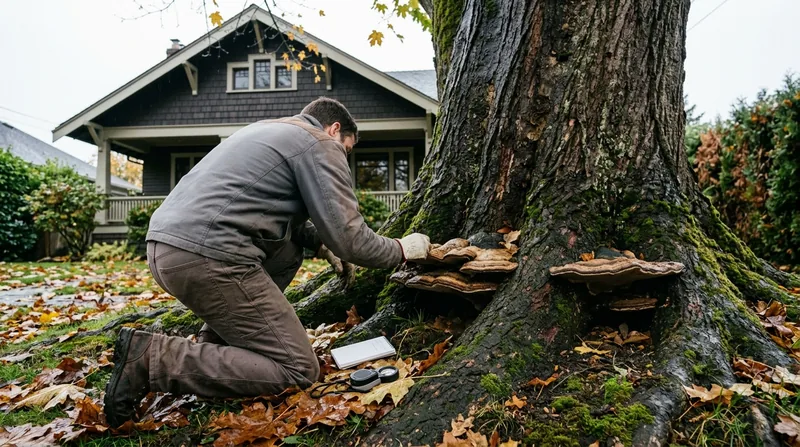
- We inspect the trunk and main branches for cankers, sunken bark and fungal fruiting bodies.
- We probe the root flare and surrounding soil for decay, compaction and water damage.
- We document findings in a written report with clear, actionable recommendations.
- We explain what you can do now and what professional treatment or removal looks like.
This systematic approach protects your investment and your safety. Many trees thought to be dying can be stabilised with pruning or cabling. Others are better removed before they fail.
Local insight: Western redcedar dieback is the signature tree-health issue across Victoria and the surrounding area. We diagnose it in roughly 40 percent of our assessments, often treatable with deep watering through dry summers and selective pruning to reduce crown stress.
Our Diagnosis Process in the Victoria Area
A thorough tree disease diagnosis takes time and expertise. We do not rush the inspection or guess at the cause. Our process is designed to give you confidence in the recommendation and clarity about next steps. Whether the tree can be saved or needs to be removed, you will know exactly why.
Here is how we work on your property:
- We arrive on site with binoculars, probe tools, and a notebook to examine the tree in full light.
- We climb or use a bucket lift if needed to inspect upper branches and the crown interior for hidden decay.
- We take photographs of symptoms, fungal growth and structural defects for your records.
- We discuss our findings with you on the spot, answering questions about what we observe.
- We deliver a written report within 48 hours with diagnosis, risk level and treatment or removal options.
- We provide a separate estimate for any recommended work, whether pruning, cabling or removal.
This transparent approach means you are never surprised by a bill or a recommendation. You own the decision.
Example: A Colwood homeowner noticed a 25-metre Douglas-fir leaning after heavy rain. Our diagnosis found root rot in the lower flare and soil compaction from a recent driveway project. We recommended cabling and soil remediation rather than removal, saving the tree and avoiding a $3,500 removal cost. The written report supported a claim with the contractor's insurance.
What We Look For: Common Tree Diseases in Victoria
Victoria's climate and soil create conditions for specific diseases. We are trained to identify them quickly and accurately. Some are treatable; others require removal. Here are the most common problems we diagnose:
| Condition | Signs | Outlook |
|---|---|---|
| Western redcedar dieback | Browning and thinning from top down, branch die-off, sparse foliage in summer. | Treatable with deep watering, mulch and selective pruning to reduce stress. |
| Root rot and decay fungi | Soft or hollow sections at the root flare, mushroom fruiting bodies, sudden lean. | Depends on extent. If structural roots are sound, pruning and cabling may stabilise. Advanced decay often requires removal. |
| Canker diseases | Sunken, cracked or bleeding bark on trunk or main branches; branch dieback above the canker. | Prune out infected branches below the canker. If the trunk is girdled, removal may be necessary. |
| Environmental stress | Drought stress, waterlogging, soil compaction, root damage from construction or grade change. | Often reversible with soil remediation, improved drainage, deep watering and mulch. |
Each diagnosis is specific to your tree and your property. We do not apply a generic template; we look at what your tree is telling us and what your site conditions are.
Permits and Documentation in Victoria
The City of Victoria may require a permit for a private tree removal, often with replacement-planting conditions. Our written diagnosis and recommendation form the foundation of a permit application. Many arborist reports also satisfy municipal requirements for risk assessment. Rules differ from one municipality to the next across the Victoria area, so we always advise you of local requirements before you proceed.
We also document all findings photographically and in writing, so you have a clear record for your insurance company, a contractor or your municipal file. Active bird nests are protected under provincial law, so we check for nesting before any spring or early-summer work begins. Approach distances must be respected around your private electrical service entrance; if a tree touches the public distribution network of BC Hydro, we refer that hazard to BC Hydro and do not work on the lines ourselves.
Our diagnosis gives you the information you need to make an informed decision and move forward with confidence. Learn more about our arborist reports and risk assessments.
Next Steps After Your Diagnosis
Once we deliver our report, you have clear options. If the tree can be treated, we outline the work, timeline and cost. If pruning is recommended, we can schedule that immediately or in the appropriate season (structural pruning is best done in dormancy, late fall to late winter). If removal is the best choice, we provide a separate estimate for safe takedown and stump grinding. If the tree is healthy but at risk from nearby hazards, we may recommend tree cabling and bracing to improve stability.
We are fully insured and have been serving Victoria and the surrounding municipalities since 2013. Our ISA Certified Arborists bring years of experience diagnosing trees in local clay soils, on ravine lots and in wet winter conditions. Contact us now for a free estimate, or call (778) 562-9545 to discuss your tree's symptoms.
Prices Tree Disease Diagnosis in Victoria — Indicative pricing
| Service | Price | Details |
|---|---|---|
| Tree disease diagnosis and inspection | From $195 | On-site assessment, written report with photos and recommendations |
| Diagnosis with climbing inspection | From $295 | Includes crown interior and upper branch examination for hidden decay |
| Arborist report for permit application | From $395 | Detailed written assessment suitable for municipal or insurance documentation |
| Multiple trees on property | From $495 | Comprehensive site assessment of three or more trees with single report |
| Emergency or same-day diagnosis | From $295 | Available 24/7; response within 2 hours in Victoria |
| Free estimate | No charge | Initial phone consultation to determine if a full diagnosis is needed; call (778) 562-9545 |
Indicative prices; free, personalized estimate within 24h at (778) 562-9545.